What happens when the same farmer, managing two similar neighboring fields with access to very different amounts of water? The SWRI team, pilot leaders in the Pinios, Greece, Living Lab analysed the data of the past few years to find out. The answer, it turns out, sheds important light on how farmers make decisions under uncertainty.
A near-perfect natural experiment in water management
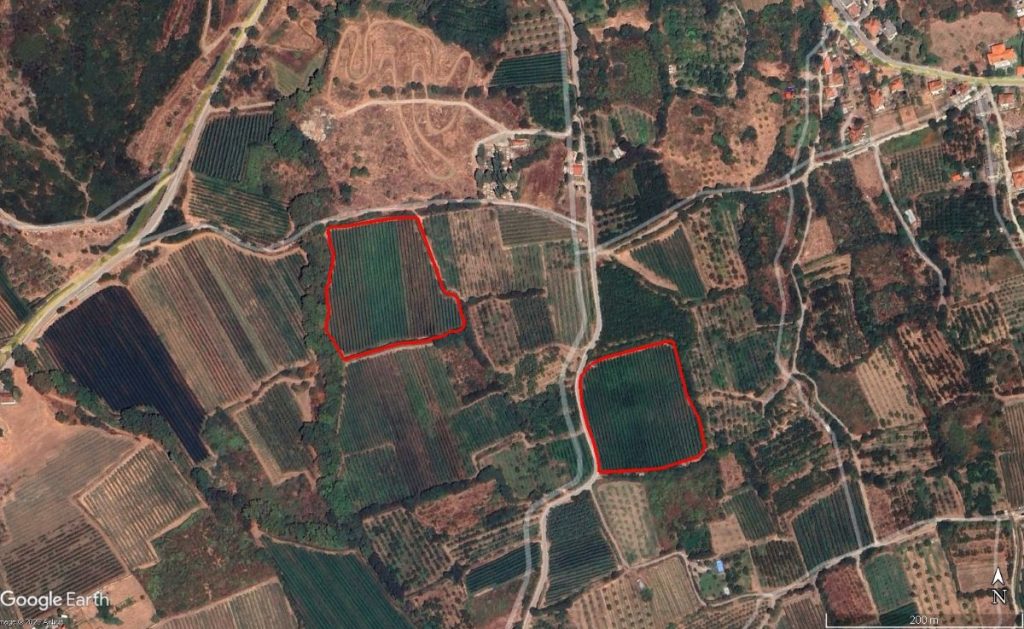
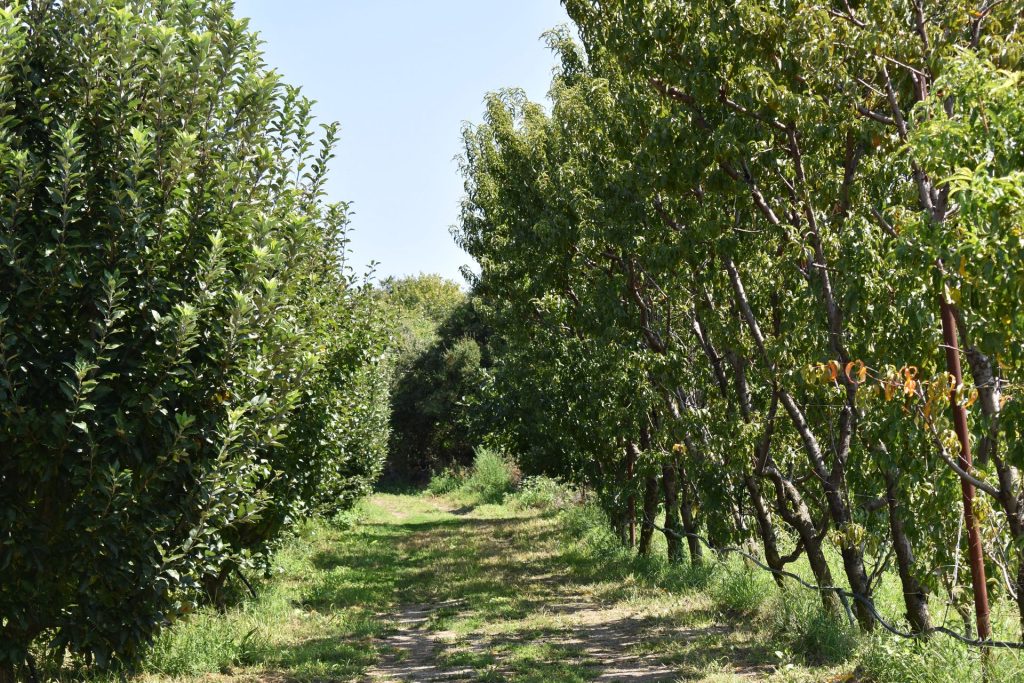
Two apple orchards in the Agia region of central Greece sit less than 300 meters apart. They belong to the same farmer, they share the same crop and microclimate. The only difference between them is water availability: Field S10 has relatively reliable and abundant access to irrigation water; Field S9 operates under a limited supply.
This single difference makes the two fields an unusually clean basis for comparison – a natural experiment rarely available in real agricultural settings.
What the data shows: 2022–2025
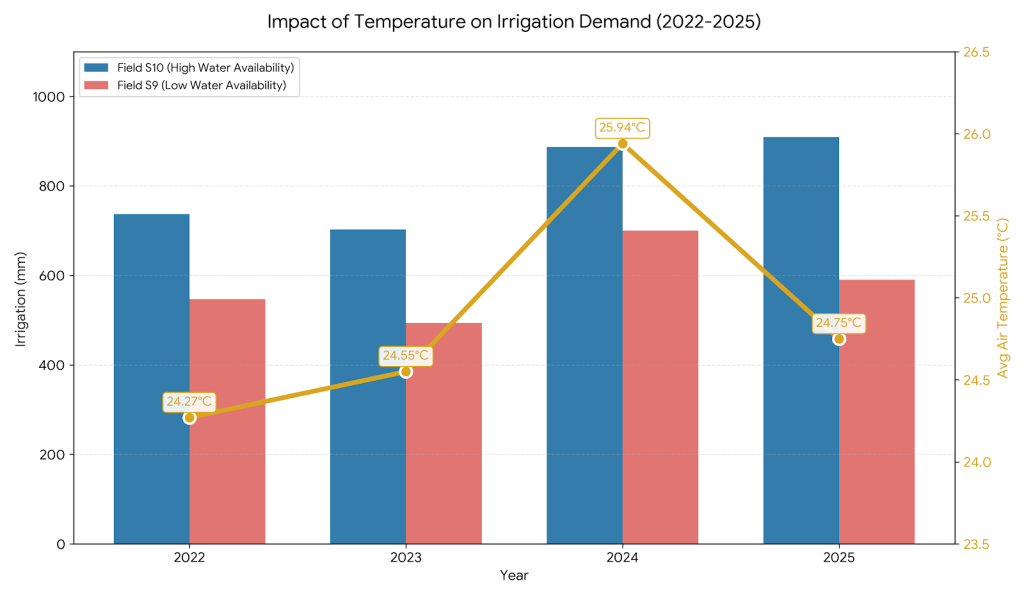
The long-term trend shows a notable but stable difference in irrigation levels in the two fields: average annual irrigation applied in S9 between 2022 and 2025 was approximately 570 mm, whereas in S10 it was 820 mm – a difference of more than 40%. It is worth noting that the intermittently available data on crop yields suggests while S9 yield was somewhat lower, the difference was much smaller than the difference in irrigation.
What about changes over time? Across the study period, irrigation in both fields responds predictably to climatic variability. When average growing season air temperatures rose sharply in 2024 – reaching 25.94°C compared to approximately 24.3–24.5°C in prior years – irrigation volumes increased in both fields. The grower was protecting the crop from heat stress, and both fields reflect that response in roughly similar proportions. Up to this point, there is no strong divergence in the year-to-year change.
But a surprising change occurs in 2025. Temperatures returned to near-normal levels (24.75°C). In Field S9, where water supply is limited, irrigation dropped accordingly – falling back to approximately 590mm, broadly consistent with previous non-drought years. In Field S10, where water is higher, irrigation actually continued to rise, reaching 910mm – its highest level in the study period.
Same farmer. Cooler year. More water applied, instead of less.
Rational behaviour, irrational outcomes
The most straightforward explanation is risk aversion in the context of low water costs. In much of this region, irrigation water is priced at little more than the energy cost of pumping — a small fraction of total production costs. For a farmer who experienced genuine heat stress in 2024, the rational response in 2025 is to over-insure: apply more water, reduce the perceived risk of crop damage, protect the investment already made in agro-chemical inputs and labor. Without field-level data on actual crop water needs, there is no strong signal guiding the farmer to do otherwise.
In Field S9, the physical constraint on water supply is effectively acting as the corrective signal that water pricing never sends. The farmer is not necessarily making a better-informed decision – rather, he is being forced to align with biophysical reality regardless of their preferences.
A local case, a systemic challenge
This case illustrates a dynamic that extends well beyond these two fields. Across Mediterranean agriculture, water is frequently underpriced relative to other inputs, access is uneven, and climatic uncertainty is increasing. Under these conditions, over-irrigation is often a locally rational strategy — even where it leads to inefficient use at a systemic level. Physical scarcity, where it exists, imposes discipline by necessity. But scarcity is a blunt and inequitable instrument, and it is not available — or desirable — everywhere.
The more sustainable path is to replace the forcing function of scarcity with the enabling function of knowledge: giving farmers reliable, field-level data on crop water requirements so that efficient irrigation becomes the confident choice, not the forced one.
What NexusLabs is doing
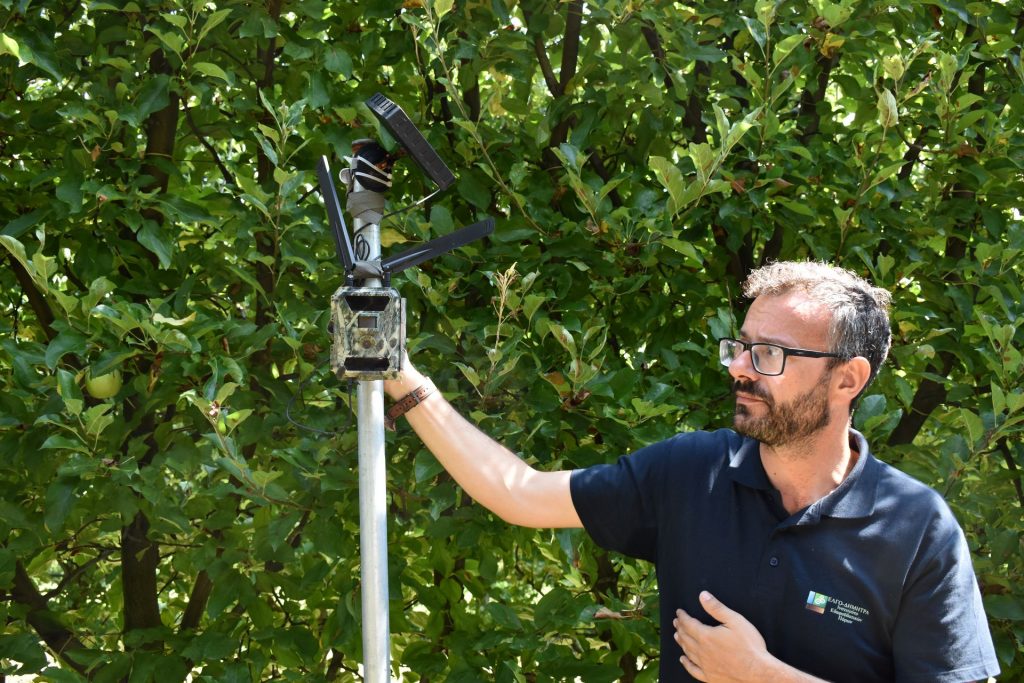
Within the framework of NexusLabs, an Irrigation Connectivity Hub is being established in the region, covering these two pilot fields and potentially many more in the area. This initiative will provide the opportunity for all fields in the surrounding area to install sensors in their own plots and joint the central newly developed sensor-based irrigation service. This will provide them with the evidence base they need to manage water efficiently.