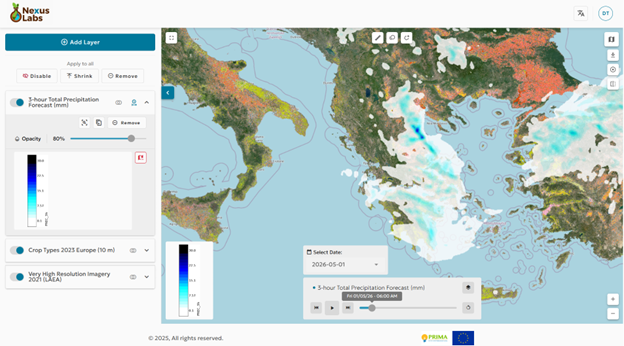
DREVEN is developing a Life Cycle Sustainability Assessment tool in Living Labs helping turn complex data into clear, practical insights across the entire food chain. These tools provide solid, evidence-based guidance for better decisions, future actions, and policy development, all backed by a robust database of evaluated results and real impacts. Alongside this, DREVEN is building a smart weather forecasting tool to support farmers with reliable predictions on temperature, humidity, and rainfall. Tying it all together, the NexusLabs Observatory will serve as a dynamic hub for insights and innovation, driving smarter and more resilient agriculture. Dimitris Tassopoulos, Project Manager explains why forecasts except for scientific accuracy have to be easy to interpret and clearly linked to real-world conditions.
Q: What are you hearing from farmers, managers and other local stakeholders?
A: What we hear most often is the need for reliable and easy-to-understand information, especially when it comes to weather conditions and water availability. Challenges like water scarcity are a constant concern. While geospatial platforms are not always familiar to everyone at first, people quickly see the value when the information is practical and easy to use.
Even though the tools are still being tested within NexusLabs, the weather forecast service has already generated strong interest across the Living Labs. From our experience in similar projects, when forecasts are clear and tailored to a specific location, they tend to be very well received.
Q: Mention one challenge you are facing on the ground, or ‘bet’ that needs to be won?
A: One of the main challenges is turning complex weather and environmental data into something simple and useful. The real “bet” is whether we can make high-quality forecasts accessible in a way that people can easily understand and trust, without needing technical expertise.
Another challenge comes from the Life Cycle Assessment (LCA) part of the work, where data from pilot sites is not always easy to find or consistent. That said, we are making good progress with the support of the Living Labs, which are key in helping us gather and validate this data.
Q: Some activities or results we should expect soon?
In the coming months, we will continue improving both the NexusLabs Observatory platform and the weather forecast service. This includes adding more datasets, making the platform easier to use, and improving how forecasts are delivered so they are more accurate and locally relevant. These will be tested together with stakeholders in the Living Labs.
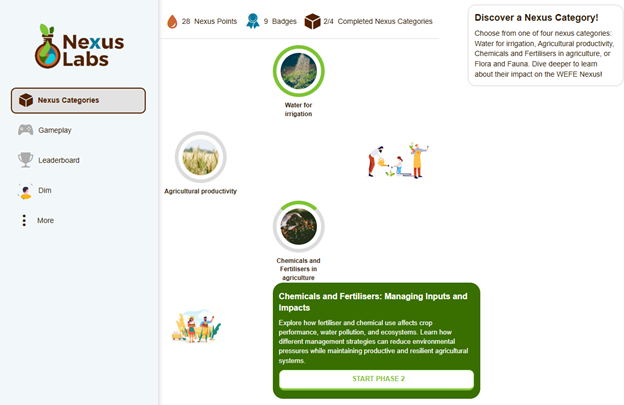
At the same time, we are also developing the NexusLabs Serious Game prototype, which is designed to help users better understand nexus-related challenges in a more interactive way. A first version of the game is already available online and will continue to evolve based on users’ feedback.
We will also start integrating results from the LCA work into the Observatory, where they will be visualized to give a clearer picture of the environmental performance of different agricultural and irrigation practices in the Living Labs. At this stage, life cycle impact assessment results will focus on depicting the baseline environmental profile of each Living Lab. In this frame, impact hotspot analyses are to be conducted to identify which are the main sources of the biggest environmental impacts when NexusLabs technological solutions are not implemented
Q: What have you learned so far? Any surprises?
A: At this stage, results within NexusLabs are still emerging. However, based on our previous experience, one key lesson is that clarity and usability are just as important as forecast accuracy. A consistent insight is that users engage much more when forecasts are easy to interpret and clearly linked to real-world conditions. It will be interesting to see how this translates within the NexusLabs Living Labs.
Q: How does this work connect to your experience as a researcher or institution?
A: This work builds on DREVEN’s broader experience in weather and climate modelling, environmental assessment (including LCA), and geospatial data platforms. We also bring strong expertise in integrating complex datasets and developing decision-support tools that help turn data into useful insights. In NexusLabs, these elements come together by delivering weather forecast services through the Observatory platform, while also integrating environmental assessments and exploring new ways to communicate complex information, such as through the NexusLabs Serious Game.